
Twist of Fate
Season 9 Episode 7 | 26m 24sVideo has Closed Captions
Life can twist in an instant, taking turns you never saw coming.
Life can twist in an instant, taking turns you never saw coming. Paul’s vacation from Honduras to Boston expands into a new life; After being evicted Michele lands just where she needs to be to say goodbye to her dad; and Samantha lets go of her dream, until grief and an invitation lead her back to her voice. Three storytellers, three interpretations of TWIST OF FATE, hosted by Theresa Okokon.
Problems playing video? | Closed Captioning Feedback
Problems playing video? | Closed Captioning Feedback
Stories from the Stage is a collaboration of WORLD and GBH.
Twist of Fate
Season 9 Episode 7 | 26m 24sVideo has Closed Captions
Life can twist in an instant, taking turns you never saw coming. Paul’s vacation from Honduras to Boston expands into a new life; After being evicted Michele lands just where she needs to be to say goodbye to her dad; and Samantha lets go of her dream, until grief and an invitation lead her back to her voice. Three storytellers, three interpretations of TWIST OF FATE, hosted by Theresa Okokon.
Problems playing video? | Closed Captioning Feedback
How to Watch Stories from the Stage
Stories from the Stage is available to stream on pbs.org and the free PBS App, available on iPhone, Apple TV, Android TV, Android smartphones, Amazon Fire TV, Amazon Fire Tablet, Roku, Samsung Smart TV, and Vizio.
Providing Support for PBS.org
Learn Moreabout PBS online sponsorshipMICHELE LUCHS: I go to the border and I say the four most impossible words: "My father is dying."
PAUL FRANCISCO: Now, Honduras, I was safe.
I felt empowered, I had a sense of identity.
Here, I was confused.
SAMANTHA TALORA: Now what do I do?
I gave up my dream, I gave up my voice.
I chose this path.
But this path didn't choose me back.
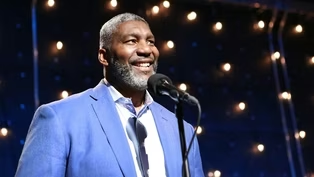
THERESA OKOKON: Tonight's theme is "Twist of Fate."
Life changes in an instant.
It can be a chance encounter, a missed train, a message that you weren't expecting.
Life is full of these turning points that we just don't see coming.
But tonight's stories are not just about being surprised.
Tonight's stories are about transformation.
About that moment when you take a turn that you weren't supposed to take, and after that, everything changes.
♪ ♪ FRANCISCO: My name is Paul Francisco.
I am an immigrant from Honduras.
I've been in Boston now for the last 35-plus years, and I happen to have the privilege of serving as chief diversity officer at a major financial services institution.
What role does storytelling play in the work that you do?
FRANCISCO: Storytelling is extremely important to the work that I do.
That's how you preserve history, that's how you educate the future leaders, that's how you paint a world that is better, that is fairer, that is just, and that is inclusive.
OKOKON: So when you consider this story that you're going to be sharing, what more do you hope that the audience takes away from that story?
I just hope the audience takes away that there is hope in the face of challenges, that there are things that you can do that will test your limits in a way that will make you stronger and more resilient.
I hope that people like me, who are immigrants to this country and who have faced challenges of being in a place where they don't necessarily feel like they belong, can find themselves, find their voice.
It's a beautiful 85-degree morning.
I'm 17 years old and I'm getting on an airplane for the first time.
I'm leaving my native Honduras to fly to Boston on November 28, 1986.
I arrive to Boston that evening to 27-degree weather.
(audience laughs) Welcome to the U.S.A.
(audience chuckles) I'm here with my mother for a two-week vacation.
I am thrilled.
I am so excited to get to know the big, bright lights of the city.
So, we arrive to Logan Airport.
We are driving through downtown Boston.
I am in awe of all the beautiful building architecture, and for the next two weeks, I enjoyed myself.
Two weeks are up, I am excited, I'm coming back home.
I am packing my bags, I'm putting the trinkets away, of all the T-shirts that I bought at Faneuil Hall.
(audience laughs) And here comes my grandmother and my mom into the room that I was sharing with my two little cousins.
My grandmother, the matriarch of the family, is doing all the talking.
And she says, with a very somber face, "Son, your mom and I decided that you're going to stay."
And my mom had this very sad look on her face.
I said, "Mom, you don't want me?"
I'm the oldest of five.
I felt like my life was back in Honduras.
And she said, "No, I want you.
I want you to be successful, I want you to stay."
So I did.
For the next six months, I endeavored to learn English.
I endeavored to get used to the food.
I was used to my arroz con frijoles.
I was used to my salsa.
And I endeavored to find my identity, to find my voice.
Now, Honduras, I was safe.
I felt empowered.
I had a sense of identity.
Here, I was confused.
The twist of faith came when I decided I was going to go back to school, because I wanted to learn English and I wanted to go to a four-year university.
I was fortunate enough to find Cathedral High School in the South End.
One day, I happen to be walking down the hall.
And someone yells at me, "Hey, you!
You look pretty tall-- you play football?"
(audience chuckles) I said, "Yeah, I play football."
(audience laughs) That decision changed the trajectory of my life.
The next day, I showed up to what I thought was fútbol.
(audience laughs, applauds) Right?
Those were the days of Pelé and Maradona and all the stars I grew up idolizing.
Uh, but that wasn't it, it was American football.
And, um, the coach approached me, said, "Son, if you want to learn, I'll teach you."
I decided to learn, and I did.
In fact, I learned so well that I was the only student athlete my senior year from that team that made it to a Division I football program.
I ended up going to Boston University, majored in political science.
I thought I wanted to save the world.
I thought I wanted to be a civil rights lawyer.
At the beginning of my senior year, my coach approached me and said, "Hey, "I don't know if you noticed, "but there have been some NFL scouts here looking at you, and you have an opportunity to make it to the league."
Me?
I didn't even know what football was six years ago.
(audience laughs) And I can make it to the NFL?
Okay.
I was projected as a seventh-round draft pick that year.
It wasn't to be-- I didn't get drafted.
Another decision point for me.
Okay, I could fold it and go on with my life, or I can give it a try and sign as a free agent somewhere.
I did.
I ended up going to Miami, with the great coach Don Shula.
(audience chuckles) After some time, I came back here to New England with coach Bill Parcells, and ended up in Cleveland, the Browns, with coach Bill Belichick.
That team actually moved to Baltimore and I became a Baltimore Raven.
It just so happened that I had an injury and I had to make a decision.
Do I get a very extensive surgery, neck and vertebrae fusing, or do I call it a day?
Called it a day.
Packed all my belongings, driving from Baltimore back to Boston.
First four hours of that trip, I was bawling, crying like a little baby.
(audience laughing) Because that part of my dream had come to an end.
Something happened-- I don't know if it was the music I was listening, maybe it was Mega 97.7, the Spanish station, when I hit New York.
But when I hit that George Washington Bridge, something changed.
A calm came over me, and I knew that it was time to move on to the next thing.
I didn't know what that was.
Three months later, I'm sitting at a Thanksgiving game.
Next to a former teammate of mine, just randomly happens to be sitting next to me.
Someone who was a senior when I was a freshman, says to me, "Have you ever thought about working in insurance?"
I said, "No."
He said, "Why don't you come by?"
You know, and, "We have this role.
I think you'd be really good at it."
I said, "Sure."
Three days later, I was sitting in front of five guys who were all looking at me, about to interview me, and I am prepared.
First time having a resumé, first time interviewing, I'm ready.
All they wanted to know was about football.
(audience laughs) Not one question about the role itself.
I left the interview thinking I bombed it.
I get a call saying, "You got the job."
I said, "Wonderful."
I started working at an insurance company as an insurance adjuster.
I was part of a 72-member class that would get trained for seven weeks at the home office.
In that class, I was the only person that looked like me.
And that greatly bothered me.
And it bothered me because I had come from a world where diversity was just abundant.
Diversity of backgrounds, skill sets, experiences, religions, political affiliations-- everything.
And so when I got on that campus and I saw that I was the only one, I asked why.
And the answer I got was, "There aren't any people "that look like you that want to come and work in insurance."
And they say, "We can't find them."
And I said, "Hm, where are you looking?"
(audience laughs) So I raised my hand and I said, "I'll help you."
Ever since that day, I decided to dedicate my life and career to ensuring that no one ever says, "We can't find people like you."
The great philosopher- slash-hockey player Wayne Gretzky once said... (audience laughs) ..."You'll miss 100% of the shots you don't take."
And I must say, throughout my life and career, I've taken a lot of shots.
Some I've missed and some I made.
Thank you.
(audience cheers and applauds) ♪ ♪ LUCHS: My name is Michele Luchs.
I am from Montreal, Quebec, Canada.
I am a curriculum developer, a writer, and a storyteller.
What's the vibe and feeling to the storytelling community in Montreal?
The vibe is really growing.
We actually have, fill theaters now of 200 people every month.
And it's, it's such a great combination of people from 20 to 70 who come to, to sit in front of people who are speaking just with a microphone, sharing important stories.
So it's lovely to see that so many people are interested in, in this kind of storytelling.
What is it about storytelling that you think keeps you coming back?
It's that connection with different parts of my life, and it's also that connection with an audience.
There's something that happens in an audience when I'm listening to stories or when I'm able to tell stories where you really feel like you're a part of something important.
♪ ♪ It's late July 2020 in Montreal.
My sister Coco calls, sobbing.
She says, "You know Dad thought he might have COVID?
"Turns out he has stage IV colorectal cancer.
The oncologist says he has weeks to live."
Oh, my God-- Dad.
I have to figure out how to be with him.
But the U.S.-Canada border is completely shut down for COVID.
I take my chances.
I go to the border, and I say the four most impossible words: "My father is dying."
The agent lets me through.
I rush down to New York City, crying most of the way.
My sister Coco, my niece Hannah, who's 26, and I move into a studio down the hall from my father to help out.
Week one, Hannah goes for errands big and small, I make my father special treats, and my sister covers him with his favorite fuzzy pink blanket while we all watch Rachel Maddow together.
(audience chuckles) By week four, he has gone downhill so fast.
He no longer eats or drinks.
He, he can barely open his eyes.
And one morning, I catch him licking his knuckles.
"What's on your hand, Dad?"
"Chocolate.
"Mom is making chocolate muffins.
She always lets me lick the bowl."
Wow.
He's losing this place and time.
I'm glad it's such a happy memory.
He's always loved chocolate.
Turns out that's the last thing I ever hear him say.
Week five, my dad is so ill, we have to transfer him to the hospital, which means it is so much harder for us.
Because it's COVID, we don't want to take subways or taxis or buses, so we walk both ways to the hospital.
Takes about an hour, and one of us inevitably forgets something-- a phone, a phone cord, which means back to the studio and back to the hospital, where the visiting hours are COVID-short, and honestly, it's like a science fiction film.
All the hospital personnel are dressed in PPE with visors and masks, and I know how hard they're working, and if we ask for anything else, they look frantic.
Tape on the ground reminds us to back off.
We try to make things nice in my dad's room.
We close the door, we put on soft music.
Hannah holds his hands, I rub water on his lips.
My sister's brought the fuzzy blanket and she covers him with it.
Week five-and-a-half, a note is slipped under the studio door.
"You will have to leave by September 1."
It is August 30.
We are being evicted without any reasons given?
It's COVID!
There are no hotels and very few Airbnbs open.
What do they expect us to do?
We spend that evening frantically looking for open Airbnbs.
And then my sister finds the jackpot.
It's closer to the hospital, there are two big beds, and it is bright and seems pretty spacious.
So the next day, we pack our bags and we drag them through the steaming city over to the apartment.
And when we get into the apartment, it is not the same one as in the ad.
This one is dingy and dirty.
There's one double bed and there are three of us.
And the agent says, "I'll bring a cot.
It's COVID-- take it or leave it."
Hannah drags us over to the balcony.
She says, "Look down."
And we are not only closer to the hospital, we are looking right over it.
And if you can count down six floors and over 13 windows, we look directly into my father's room.
"We'll take it."
That night, we bring chairs and a speaker.
Martinis, which was my dad's favorite drink, and chocolate.
And we go out onto the balcony and we celebrate my dad.
We tell stories-- crazy Dad and Grandpa stories-- we sing all of his favorite songs, and we imagine singing them loud enough that they are going through the wind and right over and into his window.
We sing "New York, New York," because this is his favorite city, and the "Piano Man."
I sing... ♪ My funny valentine ♪ ♪ Sweet comic valentine ♪ "Oh, Coco.
"Do you remember when he used to sing that to us when we were little?"
And she sings "Don't Let the Sun Go Down on Me."
Because every February, we'd meet my dad at his apartment in Puerto Vallarta, and we'd sit out on his balcony at the end of the day and belt that song into the sky as the sun dipped into the Pacific.
It's his sunset now.
It gets dark, and we have an even better view into his room.
Now we can clearly see his feet.
(audience laughs) So we bring out blankets and we watch over him all night long.
In the morning, we're awoken by the oncologist, who says, "It's time-- come quickly."
We get dressed, and we get to the hospital in less than five minutes.
We say to the guard those impossible words: "Our father is about to pass away."
And he lets us all up.
In the room, my dad is breathing like a racehorse.
We hold his hands.
We tell him how much we love him, what a great dad he was, what a great grandpa, what a great man.
And I whisper in his ear, "Don't worry, we'll be okay."
40 minutes after we arrive, his breath grows even faster, his eyelids flutter, and his feet look like they're running his last race.
And then it's quiet.
Well, what do we do now?
Do we have to tell someone?
We wait until someone finds us, and then we ask, "Could we please have a bit more time?"
Because my father is still there.
I, I can't explain it, but there is a bright light in the room that gets even brighter, and, and a few minutes later, a shaft of sun comes through the window.
And I imagine my dad watching this scene the way that we watched him the night before, through the window from the balcony.
It's so ironic.
If we hadn't been kicked out of the studio and hadn't taken that really awful Airbnb, we wouldn't have, have been able to watch over him or to be with him during these last moments.
The light dims, and I can imagine my dad flying over the city that he loved so much, off to the land of chocolate muffins.
Thank you.
(audience applauding) ♪ ♪ TALORA: My name is Samantha Talora, I live in the Berkshires of Western Massachusetts, and I work in hospitality at a wellness resort, booking programs and activities for guests, and I'm also a singer.
I'd love to hear more about your work as a singer and if there was a time in your life where you first realized that your voice could move people.
I think it was the first time that I had to sing for a family funeral.
And there were family members who I didn't see often who didn't know that I was a singer, and to know that they were moved to tears and that they were changed, and maybe felt a little bit healed because the music brought them some peace, was the first time I realized that this was bigger than me.
So tonight, you're taking the stage in a different sort of way... OKOKON: ...by telling a story.
OKOKON: Is this something you've done before?
And what has the process been like for you?
I have never done this before.
This is standing up and telling my own story.
And I'm so grateful for the experience, because it's been kind of heart-cracking-open moments... Mmm.
TALORA: ...that have helped me get to the other side of maybe where I've been a little stuck, and I am so grateful for it.
I am a singer.
From age three, four, five... (chuckles) ...anywhere I could sing, anywhere I could find an audience, that's where I'd be.
The stage just feels like home.
From elementary school right through college, I would sing everything and anything.
Choral music, musical theater, jazz standards, classical, you name it.
And after college, I'm in New York City.
Auditioning, getting rejected.
Auditioning, getting rejected.
Auditioning, getting rejected.
Not a unique story.
I feel the self-doubt start to settle in.
My boyfriend is back home in the Berkshires, and we're talking about the future, making long-term plans.
Maybe it's time for me to give up this dream.
I know I want to have a family, someday.
Might be time to go home, get a job, and get on with my life.
That's what I do, get a grown-up job.
I'm still singing a little bit here and there.
I can't give it up.
Now I'm a wedding planner.
And that job takes all of my time, all of my energy.
There's not a lot of time for singing or dreaming.
I decide it's time to focus on my career and my new goal of having a family, being someone's mom.
But that's not happening, either.
After a complicated surgery, my doctors tell me, "I'm sorry, but you're not going to be able to have a baby."
Well, now what do I do?
I gave up my dream, I gave up my voice.
I chose this path, but this path didn't choose me back.
My friend Carolyn says, "Come and sing in the church choir "with me on Sundays-- it'll be easy, it'll be fun.
We'll give you your own microphone."
(audience chuckling) It's been eight-and-a-half years since I've sung in front of anybody.
But church feels like a safe place to give it a try.
And every week, I feel my voice getting stronger.
My confidence is growing.
I'm feeling more like myself than I have in a long time.
I quit my job as a wedding planner, not to be a famous church singer... (audience chuckles) ...but to make room for something new, whatever's coming next.
People start hiring me to sing at their weddings, funerals.
And there's another woman in the choir who is a professional singer, she needs a backup singer.
She asks me-- "Absolutely, yes!"
In the meantime, my amazing 31-year-old brother, Mike, is diagnosed with stage IV melanoma.
Suddenly, I'm so grateful to be home in the Berkshires, near him, able to help with whatever he needs.
Later that summer, I'm singing backup in a concert for that same woman in the choir.
And I meet Ron.
He's a guest artist in the concert.
He's so talented, he has a gorgeous voice, he plays the piano beautifully.
And he comes up to me and says, "You have an amazing voice!
What are you doing singing backup?"
So we're going to be best friends.
(audience laughs) About a month later, just five months after he was diagnosed, my brother died.
And I was inconsolable.
He was my little brother.
From the day he was born, I was his protector.
I could not protect him from this.
Not long after that, Ron called me.
"I'm doing a concert next month.
Will you come and sing in it?"
And I could barely breathe, let alone sing.
"I'm so sorry," I tell him.
"I'm going through a really difficult time personally.
I just can't, I can't do it right now."
He says, "I understand-- just think about it.
It might be just what you need."
We hang up the phone.
And after that, things got really dark, really hard.
I kept having this thought over and over.
"It's going to be a really long, hard life "without my favorite person, my brother, "who just made everything fun and joyful.
And I don't know if I want to wait and find out how long."
One particularly challenging evening, that thought was really loud in my head, and I knew I had to do something fast to change it.
I remembered Ron.
"Maybe this is exactly what you need."
I really hope so.
I pick up the phone.
"Okay, Ron, I'll do it."
And that was 11 years ago.
Ron and I have been a duo ever since.
Now I work at a wellness resort and I book entertainment and special programs for the guests there.
One of my favorite projects is "Broadway in the Berkshires."
It brings wonderful New York artists up to perform for the guests.
In 2022, I invited composer David Friedman to come and sing an evening of his music.
So beautiful, soothing, healing-- I've been an admirer of his for so long.
After the concert, we're chatting.
I say, "I sing!"
I have no idea why I did that.
(audience laughs) So he says, "Oh, sing something."
(exhales) And after I finished, he just stared at me.
"What are you doing hiding in the Berkshires "at a wellness resort?
(audience chuckles) "You should be singing everywhere.
"I would love to work with you.
I would love for you to sing my music."
Fast-forward, December of 2024, I made my New York solo show debut with David at the piano and Ron right by my side.
And as I was standing backstage before the concert began, I felt this incredible sense of calm come over me.
This is where I belong.
A winding road and some very well-placed friends helped me find my way home.
This is what I do.
I sing.
♪ As long as I can sing ♪ ♪ As long as there's a melody ♪ ♪ Inside of me ♪ ♪ I have a voice ♪ ♪ I can face anything ♪ ♪ As long as I can sing ♪ Thank you.
(cheering and applauding) ♪ ♪
Video has Closed Captions
Preview: S9 Ep7 | 30s | Life can twist in an instant, taking turns you never saw coming. (30s)
Providing Support for PBS.org
Learn Moreabout PBS online sponsorship










Support for PBS provided by:
Stories from the Stage is a collaboration of WORLD and GBH.