
December 12, 2025 - PBS News Hour full episode
12/12/2025 | 57m 46sVideo has Closed Captions
December 12, 2025 - PBS News Hour full episode
Friday on the News Hour, President Trump and many other notable figures appear in newly released photos from Jeffrey Epstein's email, a U.S. Special Forces veteran who helped smuggle Venezuela's opposition leader out of the country to accept the Nobel Peace Prize details the operation and centuries-old olive groves in the West Bank sit untouched because of repeated attacks from Israeli settlers.
Problems playing video? | Closed Captioning Feedback
Problems playing video? | Closed Captioning Feedback
Major corporate funding for the PBS News Hour is provided by BDO, BNSF, Consumer Cellular, American Cruise Lines, and Raymond James. Funding for the PBS NewsHour Weekend is provided by...
December 12, 2025 - PBS News Hour full episode
12/12/2025 | 57m 46sVideo has Closed Captions
Friday on the News Hour, President Trump and many other notable figures appear in newly released photos from Jeffrey Epstein's email, a U.S. Special Forces veteran who helped smuggle Venezuela's opposition leader out of the country to accept the Nobel Peace Prize details the operation and centuries-old olive groves in the West Bank sit untouched because of repeated attacks from Israeli settlers.
Problems playing video? | Closed Captioning Feedback
How to Watch PBS News Hour
PBS News Hour is available to stream on pbs.org and the free PBS App, available on iPhone, Apple TV, Android TV, Android smartphones, Amazon Fire TV, Amazon Fire Tablet, Roku, Samsung Smart TV, and Vizio.
Providing Support for PBS.org
Learn Moreabout PBS online sponsorshipGEOFF BENNETT: Good evening.
I'm Geoff Bennett.
AMNA NAWAZ: And I'm Amna Nawaz.
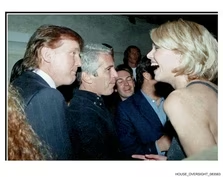
On the "News Hour" tonight: President Trump and many other notable figures appear in newly released photos from the late convicted sex offender Jeffrey Epstein's files.
GEOFF BENNETT: The U.S.
Special Forces veteran who helped get Venezuela's opposition leader out of the country to accept a Nobel Peace Prize details the complex and harrowing operation.
AMNA NAWAZ: And centuries-old olive groves in the occupied West Bank sit untouched during harvest season because of repeated attacks from Israeli settlers.
AFAF ABU ALIA, Victim of Settler Attack (through translator): They beat me over the head nearly 10 times and then they beat the rest of my body.
It's really painful.
Now I can't go back to collect olives because of my brain injury.
(BREAK) AMNA NAWAZ: Welcome to the "News Hour."
Newly released photos are offering a closer look at the influential and wealthy people who spent time with convicted sex offender Jeffrey Epstein.
GEOFF BENNETT: Democrats on the House Oversight Committee say the batch of previously unreleased images came directly from Epstein's estate, and they include multiple images of President Trump and former President Bill Clinton, among others.
It's not immediately clear when or where the photos were taken.
For more, we're joined now by White House correspondent Liz Landers.
Liz, thank you for being here.
First, we should be clear that these documents today are coming from Democrats in Congress.
These are not documents from the Justice Department.
Democrats have been rolling these materials out gradually, keeping the story alive.
What's new in this latest release?
LIZ LANDERS: So these are 90 or so more images that we're getting today, as you mentioned, selectively being released by the Democrats over the last few weeks and months.
These images today depict Epstein and the people that he socialized with.
Some of these images, three of them, do contain photos of President Donald Trump.
This was before he was president.
One of these photos is him with six women.
All of their faces are redacted.
They are out of luau there, it looks like.
There's another photo of the president speaking with a woman.
Her face is visible in this photo.
And Epstein is standing beside Trump.
And then there's a final picture of Trump on an airplane, it appears, sitting next to a blonde woman who also has her face redacted.
Now, I should be clear, the president is not accused of any wrongdoing in connection with Jeffrey Epstein.
He said that they had a falling out many years ago because he thought that Epstein was a creep.
Now, there are other very famous high-profile people that are also in some of these pictures that were released today, including former President Bill Clinton.
He's photographed with Epstein and Ghislaine Maxwell, who was his former girlfriend.
There's also a photo of Steve Bannon sitting at a desk.
There are a number of other images of Woody Allen, Bill Gates, and more.
There were also some sexual - - sexually explicit images in here of sex toys.
There has been a lot of pressure on the administration to release more of these Epstein files, images, information to the public.
We heard from Democrat Robert Garcia earlier today about that.
REP.
ROBERT GARCIA (D-CA): The thing right now that's the most important is, there's one man who has the power to release the files and get to the truth and bring justice to the survivors.
And that's Donald Trump.
And Donald Trump right now needs to release the files to the American public, so that the truth can come out and we can actually get some sense of justice for the survivors.
LIZ LANDERS: The congressman said that they have only released a fraction of what the committee has.
They have apparently obtained more than 95,000 images.
Only 90 or so of those came out today.
GEOFF BENNETT: So how is the White House responding to today's release and the broader pressure around the Epstein files?
LIZ LANDERS: So White House Deputy Press Secretary Abigail Jackson sent over a statement to us.
And she says that this is a cherry-picked release from the Democrats.
They're trying to create a false narrative.
And she says in part -- quote - - "The Democrat hoax against President Trump has been repeatedly debunked and the Trump administration has done more for Epstein's victims than Democrats ever have by repeatedly calling for transparency and releasing thousands of pages of documents and calling for further investigations into Epstein's Democrat friends."
We have heard the president repeatedly call this a hoax as well.
GEOFF BENNETT: So the administration's deadline to release the Epstein files under the new law is next Friday, December 19.
What should people realistically expect when that deadline arrives?
LIZ LANDERS: So this was passed in Congress, and President Trump at kind of the 11th hour endorsed Republicans voting for this.
He signed this into law just a few weeks ago.
And this requires the attorney general to release - - quote -- "all unclassified records, documents, communications and investigative material related to Epstein and Ghislaine Maxwell."
But this does give the Attorney General Pam Bondi the power to withhold information related to ongoing investigations or anything that identifies victims, Geoff.
GEOFF BENNETT: And as we have been sitting here speaking, the president was speaking to reporters in the Oval Office.
And in response to a question, he said this is no big deal.
Certainly more to come.
Liz Landers, thanks to you.
LIZ LANDERS: Thanks for having me.
AMNA NAWAZ: In the day's other headlines: A group of preservationists is suing President Donald Trump over his White House ballroom renovation.
The National Trust for Historic Preservation wants a federal court to stop the project so it can go through an architectural review and win congressional approval.
Their lawsuit claims that Trump has already committed multiple violations by fast-tracking the project.
The Trump administration has argued that a new ballroom is long overdue.
The White House is expected to submit plans to a federal planning commission before the end of the year, about three months after construction began.
Weather officials say catastrophic flooding and landslides are bringing a significant risk to life and property in Washington state and Northwest Oregon.
North of Seattle, the entire city of Burlington and its 10,000 residents have been forced to evacuate.
MAN: This is wild.
You feel the whole concrete shaking.
Oh, my God.
AMNA NAWAZ: Days of torrential rains have caused historic flooding with many rivers in Western Washington at or near record levels.
Near the Canadian border, Coast Guard helicopters rescued people who were forced onto their rooftops by the rising waters.
Elsewhere, residents raced to protect their properties, while, for others, it was already too late.
WOMAN: Looks like we now have a houseboat.
Got about six feet of water underneath my house, maybe seven.
AMNA NAWAZ: Weather officials say that, even though heavy rains have stopped and water levels will start to recede, many areas will remain flooded for days.
In Gaza, residents are clearing up from Winter Storm Byron, which is flooded camps where Palestinians have been sheltering in already dire conditions.
People were forced to dig out their belongings as dirt roads turned to mud and piles of garbage and sewage piled up.
Palestinian officials have reported more than 2,500 distress calls because of the storm.
One woman who spoke to the "News Hour" says she can't sleep in such conditions.
IMAN AL-SAFADI, Displaced Palestinian (through translator): Are we going to stay like this, sleeping in tents with submerged water?
Here's the water.
Do you see it?
I don't know how long we can bear these horrible burdens and this pain.
AMNA NAWAZ: Aid groups say Israel has not met its agreement under a cease-fire with Hamas to allow 600 trucks of aid into Gaza each day.
Israel disputes this claim, saying it has allowed in truckloads of tents, blankets and warm clothing.
The E.U.
has agreed to indefinitely freeze nearly $250 billion in Russian assets, a significant step in freeing up money to support Ukraine.
Moscow claims that such a move is illegal.
It comes as the warring countries traded new attacks today.
Video showed Ukrainian firefighters battling a blaze in the Odesa region, where Ukraine's navy says a Russian strike damaged three Turkish-owned vessels.
Separately, Ukraine says its drones hit two Russian oil rigs in the Caspian Sea.
Meantime, Ukrainian President Volodymyr Zelenskyy visited troops in Kupiansk in the Northeastern Kharkiv region.
Russia had claimed to control the frontline city, but Ukraine says it has retaken parts of the area and has Russian troops surrounded.
President Trump says that Thailand and Cambodia have agreed to stop the latest round of violence along their shared border.
In a social media post, Mr.
Trump wrote -- quote -- "They have agreed to cease all shooting effective this evening and go back to the original peace accord made with me."
Earlier, Thailand's prime minister told reporters that his country was not the aggressor in the latest conflict and that a cease-fire with Cambodia was still out of reach.
Fighting flared up earlier this week along their shared border, leaving at least 20 people dead and hundreds of thousands displaced.
Back in this country, former University of Michigan football coach Sherrone Moore was charged with stalking and felony home invasion today.
The 39-year-old appeared in court via video as prosecutors described how he broke into the apartment of a woman with whom he'd been having an affair.
They say he then threatened to kill himself in front of her for reporting their relationship to the school.
The married father of three was fired this week for having an inappropriate relationship with a staff member.
A not-guilty plea was entered on Moore's behalf.
His next court hearing is set for late January.
On Wall Street today, tech stocks dragged on the broader markets to end the week.
The Dow Jones industrial average pulled back from its recent record, falling around 250 points.
The Nasdaq gave back nearly 400 points.
The S&P 500 saw its worst day in about three weeks.
And downhill skiing legend Lindsey Vonn made history today as the oldest ever winner of a World Cup race.
The 41-year-old's victory in Switzerland was her first such win since 2018.
It comes more than five years after she retired from the sport amid injuries.
It represents a major step in her comeback following a titanium knee replacement as she eyes the 2026 Winter Olympics.
Vonn is looking to build on her storied career which includes an Olympic gold medal and 44 World Cup downhill wins.
For a better perspective before today, the oldest World Cup winner was a 37-year-old male skier.
The last women's record holder was just 34.
Still to come on the "News Hour": how Indiana Republicans came to defy President Trump and reject congressional redistricting; the president issues an executive order to limit state regulations on artificial intelligence; and David Brooks and Jonathan Capehart weigh in on the week's political headlines.
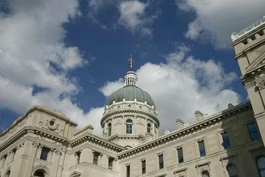
GEOFF BENNETT: President Trump's push to redraw congressional maps in Republicans' favor hit a major roadblock in Indiana yesterday.
More than 20 Indiana Republican state senators joined Democrats to vote against a plan that would likely have created two new GOP seats in the U.S.
House.
Our congressional correspondent, Lisa Desjardins, has more.
LISA DESJARDINS: After the vote in Indiana, President Trump made clear he wants political consequences for the perceived lack of loyalty.
Here's how he responded to "News Hour"'s Liz Landers.
DONALD TRUMP, President of the United States: I wasn't working on it very hard.
It would have been nice.
I think we would have picked up two seats if we did that.
You had one gentleman, the head of the Senate, I guess, Bray, whatever his name is.
I heard he was against it.
He will probably lose his next primary, whenever that is.
I hope he does.
But -- because he's done a tremendous disservice.
I will certainly support anybody that wants to go against him.
LISA DESJARDINS: One of those Republicans who voted to block the maps is Indiana Senator Mike Bohacek, and he joins me now.
Senator, you voted no, but others of your fellow Republicans, a smaller group, supported the president's move.
Here's what one of them said.
STATE SEN.
CHRIS GARTEN (R-IN): When your house is on fire, you don't worry about whether or not you're traditionally holding the hose the right way.
You do whatever it takes to put out the fire.
LISA DESJARDINS: That's a political argument.
Why did you disagree?
Why were you right?
Why did you vote no?
STATE SEN.
MIKE BOHACEK (R-IN): Sure.
We had 19 members that felt very strongly that we should move forward with this.
And we had 21 of my caucus mates that also felt, as did I,that this is more than just a transactional one-time vote.
If we're going to do this once, then are we now going to be doing this every two years with every new administration?
And we don't treat policy as this substantive in a transactional basis.
And that's kind of how I felt.
It was feeling like we're just doing this at the whim of a president who's concerned that perhaps he might be underwater in the upcoming elections.
And it was just bad policy.
I had some personal reasons as well, and I have certainly stipulated those.
But from a policy perspective, it's just bad policy.
LISA DESJARDINS: I want to talk about those personal reasons as well.
The president and his team put a lot of pressure on you.
His rhetoric has had a number of effects.
One thing he posted on Facebook at one point was, he used a slur, "retarded."
I know that's something that affected you.
You are also being affected by threats right now.
Where are you staying?
Where is your family?
And what's the president's responsibility for bringing down the rhetoric right now?
STATE SEN.
MIKE BOHACEK: Well, what's interesting is, he hasn't brought the tone down, which I was kind of surprised about.
And it seems like it's just kind of amplifying it.
But, hopefully, things will calm down.
My family and my children, my wife and my children are staying at a friend's house.
I'm staying elsewhere as well.
So we're going to try to get everybody back together for the weekend and as we approach the holiday season.
I have a daughter that's disabled.
And I can listen to a lot of the president's comments and some of the names that he calls that I don't appreciate it.
I don't like it.
But that's just how he is.
But just this one slur just -- it was just the bridge too far.
And it doesn't seem to matter.
Other members of his administration have used it.
He's using it to identify a political rival.
There's just no place for it.
And it's time to be grownups.
For God's sakes, we're the -- we're leading -- in this case, we're leading the state of Indiana.
And in his case, he's leading the free world.
There's many other words you can use if you need to voice your displeasure with someone.
LISA DESJARDINS: There is a top conservative group that's still putting some rhetoric out there today Heritage Action posted on X in the last day that President Trump should make good on his threat to cut Indiana's funding, writing: "Roads will not be paved.
Guard bases will close."
Are you worried about that threat for your state?
STATE SEN.
MIKE BOHACEK: I don't think he can do it.
From the research I have done and others, the roads are formulary.
Entitlement programs like SNAP and Medicaid, well, those are federal entitlements.
I don't think you can unfund those.
So can he impact grants and maybe some discretionary issues?
Certainly, he can.
But we have nine members of our congressional delegation, plus two senators.
And with the majorities as tight as they are, and the votes as tight as they are in Congress, hopefully, our state delegation will represent the state of Indiana and its interests at the federal level.
And I would count on them to do that.
LISA DESJARDINS: There are just 40 of you Republican senators in Indiana, but you were under a national pressure campaign, including visits from the vice president.
Who exactly said what to you during that pressure campaign?
STATE SEN.
MIKE BOHACEK: So it started pretty early on with the vice president and some of his visits.
Obviously, the social media campaign was pretty revved up.
We did meet with the -- some of the president's staff and also the vice president as a caucus, as a group of the 40 Republican senators.
And then, later on, a conference call with the president.
I received one call from president's staff and then also calls from our governor and his staff as well.
So it was pressure.
With as much as going on in the world these days, for him to take out time to spend with us to discuss this, you obviously see the importance of the issue to him.
LISA DESJARDINS: What do you make of this effort overall to try and affect the 2026 election by changing all these maps?
You obviously were against it in Indiana.
STATE SEN.
MIKE BOHACEK: I don't feel comfortable with it.
I think it's bad policy.
So to now say, well, let's take this opportunity to politically gerrymander them just -- it doesn't feel right.
And my constituents don't like it.
To them, it feels like we're trying to rig the system and steal and using other states' bad behavior as the excuse.
That's just not how folks in Indiana are.
LISA DESJARDINS: You have heard that from voters specifically?
STATE SEN.
MIKE BOHACEK: I have.
Yes, I have heard -- obviously, you have voters that are pretty strong on the other side of this issue.
And I'm happy they are.
And they made their voices clear and known.
But, by and large, members of my constituency overwhelmingly did not want to do this.
They did not want the districts to be redrawn.
And it became even stronger after they saw the maps.
So when they saw the maps and they saw that, in some cases, they're going to be represented by somebody that's in a community that's not even close to being of their same interests, even they were concerned.
Even people that were in favor of it on its face, when they saw the maps, changed their minds.
LISA DESJARDINS: Indiana State Senator Mike Bohacek, thank you so much for talking with us.
STATE SEN.
MIKE BOHACEK: Thank you.
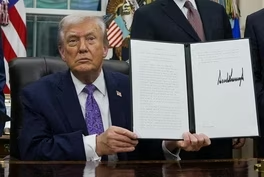
GEOFF BENNETT: President Trump late yesterday signed an executive order blocking states from enforcing their own laws regulating artificial intelligence.
Specifically, it gives the Justice Department authority to block state laws if they do not support -- quote -- "global dominance of A.I."
It would also allow the federal government to withhold funding for broadband and other projects.
The directive marks a big win for tech giants, but will likely be challenged in the courts.
During the Oval Office signing yesterday, the president's A.I.
and crypto czar, David Sacks, an investor in multiple A.I.-related companies, argued that allowing states to set their own rules poses significant risks.
DAVID SACKS, White House A.I.
and Crypto Czar: Over 100 of them have already passed; 25 percent of them are in California, New York and Illinois.
You have got 50 states running in 50 different directions.
It just doesn't make sense.
We're creating a confusing patchwork of regulation.
What we need is a single federal standard.
GEOFF BENNETT: For more, we're joined by tech journalist Jacob Ward, founder of The Rip Current.
Jacob, welcome back to the "News Hour."
JACOB WARD, Founder, The Rip Current: Thanks, Geoff.
Great to be here.
GEOFF BENNETT: So President Trump in this executive order says he wants a minimally burdensome national standard.
The White House argues that tech companies can't reasonably be expected to comply with potentially 50 different sets of state laws.
Break down that argument for us.
JACOB WARD: Well, the argument, right, has these two sides.
One is that we need some sort of comprehensive federal regulation for there to be, as President Trump's executive order describes it, supremacy when it comes to the United States.
There is some real rah-rah football team backer kind of language in this executive order that we need to win.
It mentions adversaries, which, of course, means China.
And so the argument here is that we need to streamline the development of this industry so that we can be the global winner on it.
The other side of the argument, of course, is that the states have always been the laboratory of democracy.
They are the place where we figure out what regulations work and what don't.
And, right now, more than 50 -- all 50 states plus Puerto Rico have passed an A.I.
regulation of some form.
You have got Colorado banning algorithmic discrimination.
You have got Illinois trying to wipe out A.I.
therapy.
And so when it comes to the states' arguments, they say, essentially, we need to figure out how to regulate this stuff.
And the backdrop of all of this, right, Geoff, is that there is no federal regulation around this stuff at all.
We're almost -- we're 20-plus years into the social media revolution.
We still don't have a data privacy law that touches that, much less anything that regulates A.I.
whatsoever.
There is some new legislation possibly coming up.
But, at the moment, there's nothing there.
So you can't really blame the states for feeling they have to get involved.
And President Trump has now moved to try to get out in front of that.
GEOFF BENNETT: If this order survives legal challenges, what are the real-world consequences?
What protections potentially could be lost?
JACOB WARD: Well, you should sort of think of the promises, the marketing language of these companies almost in reverse.
Let's say they get their way and these technologies make their way into every corner of our life.
We know already that algorithmic systems are determining who gets a job, who gets a loan, who gets bail.
But we also know that increasingly people are forming deep personal attachments to this stuff.
One in five teenagers report having a deep emotional connection to a chatbot of some form.
And so we know that there is -- both anecdotally and quantitatively, we know that there is an enormous effect being had on humans of all ages and all backgrounds across the United States.
And so the attitude of the technology industry has always been, let us innovate and we will figure it out later.
And it seems as if the Trump administration has come along and bought that argument, the idea that we should be able to experiment in the wild on live subjects in a way that no university would ever permit.
But, as a result, of course, we are also the envy of the world when it comes to the creation of these foundational models.
And it could be that keeping that dominance going will keep us on top as a superpower.
But this - - the fact of the matter is, we really -- if these companies are to be believed, this stuff is about to be in every corner of our lives.
And I don't think any of us would imagine a world in which no regulation will touch it.
And, at the moment, that's the case.
GEOFF BENNETT: But are we the envy of the world when it comes to A.I.
in the absence of regulation?
Is there a case to be made that regulation really stifles innovation?
JACOB WARD: Well, the adversary that the executive order mentions is, of course, China.
And the argument that a lot of pro-industry folks make is that China only has a single regulatory body, and that is the federal government.
There is no patchwork of state law in China.
But the other thing to consider is that you have a lot of regulations in China.
China is not a wide-open, Wild West-style environment.
You have to be able to show that your A.I.
model -- it has to show its work.
It has to show that it is in compliance with communist teachings.
There are -- CEOs are personally liable if their A.I.
product is misused in some way.
So there is enormous, and I would argue, under the Trump definition, very onerous regulation in China.
And yet they are moving as fast as they are.
I think the thing that we could say about this is that the need currently to comply with this long laundry list of various patchwork-style laws across the country really does create an advantage for big companies, who can afford big compliance teams, and a disadvantage for small start-ups, who don't know how to do that.
But, increasingly, in the age of A.I., it's not that hard to come up with a checklist that satisfies all the state requirements.
And if we see the White House swing the other way and the legislature, the Senate and the House, swing the other way in the next few years, we could very easily see a federal set of federal regulations just as long as the laundry list we currently have from state law.
GEOFF BENNETT: I was going to ask you that because there is a role for Congress to play here, even though we know that Congress has abdicated so much of its authority to the executive.
We mentioned that this is headed for the courts.
When these state attorneys general sue, when they challenge this executive order, on what grounds might they file these cases?
JACOB WARD: Well, the grounds that the executive order talks about has to do with the -- a state basically interfering with commerce nationally.
You're not supposed to be able to blockade your state if you are the one national source of, I don't know, timber.
I'm making this up.
But you know what I mean?
You're not allowed to sort of hold back the business of the nation as a state.
And so that seems to be the argument here.
I think the other side of the argument is, well, you should probably -- you need to safeguard our kids, our jobs, our industries against the encroachment of this technology and some of the damage that we have seen, and without any kind of federal regulation on that stuff, then you should leave us alone, will probably be the states' argument here.
You know, this really -- what this I think does fundamentally is bring up a really big constitutional question that's been brewing for a long time, but it's about to get really white hot in this case.
But the other thing I would also point out to you, Geoff, just as a piece of context, is, this is not a thing the voters care about.
Only big companies really care about this China question and about this regulation question.
Big polls of every kind of adult voters show that the vast majority of them want regulation of A.I.
and do not care if it slows it down.
And so this is definitely not a voter response that we're seeing in this executive order.
GEOFF BENNETT: Jacob Ward, always great to speak with you, founder of The Rip Current.
Thanks again for being with us.
JACOB WARD: Thanks, Geoff.
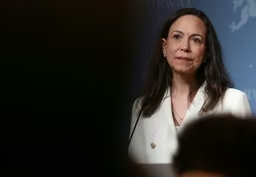
AMNA NAWAZ: Novel peace laureate Maria Corina Machado today vowed to continue her political pursuit to create democracy in Venezuela.
This week, after a year-and-a-half isolated and alone, she braved an arduous journey to accept the Peace Prize in Oslo, Norway.
Nick Schifrin speaks now with the man who helped her escape a Venezuelan government that's been hunting her for a year-and-a-half.
(CHEERING) NICK SCHIFRIN: An icon and an iconic moment, Maria Corina Machado isolated and in hiding for more than a year, reaching for and embraced by supporters this week in Oslo, hugs for someone who says she hasn't been hugged for 16 months.
Her journey from solitude to overwhelming support risked her life and the lives of an entire team.
How difficult was it to extract her from Venezuela and get her to Oslo?
BRYAN STERN, Grey Bull Rescue: On a scale of one to 10, it was about 106.
NICK SCHIFRIN: Bryan Stern is an Army and Navy veteran and chairman and founder of Grey Bull Rescue, who organized her extraction.
BRYAN STERN: We have broken people out of jail from Russia.
We have done hostages from Gaza.
We have done all kinds of things.
But the reality is, is, we have never extracted someone, rescued someone or evacuated someone that has a Wikipedia page.
NICK SCHIFRIN: The first challenge, moving Venezuela's most famous woman, who hasn't been seen in public since the middle of 2024.
BRYAN STERN: She's the second most popular person after Nicolas Maduro with billboards with her face on it.
And she has rock star level status in the country.
So, to mitigate that risk, lots of things were done to conceal her movement and her identity and her signature, both physically, digitally and in other ways.
NICK SCHIFRIN: That was the first step, getting her overland through military checkpoints from her hiding point to the coast.
BRYAN STERN: From there, she got on a boat.
And that boat was not what most people think.
It was a very small boat.
In the dead of night, she embarked on boat one to rally point in the middle of the sea, where she was met by boat two also in the middle of the sea.
The conditions were very rough, very cold, very wet, not fun at all.
NICK SCHIFRIN: Stern says that more than 150-mile journey was the most dangerous from the Venezuelan coast to the Dutch island Curacao.
Throughout, he stayed in touch with the U.S.
military, which has been targeting boats in the Caribbean.
BRYAN STERN: I lifted her from boat one into boat two personally with my own hands.
She was amazing in every way.
She was already my hero, and now she's more so.
We talked about her family.
And she was so excited to see her children for the first time in two years and things like that.
So, yes, she's an international figure and all those things, but she's also a mom.
ANA CORINA SOSA MACHADO, Daughter of Maria Corina Machado: I am here on behalf of my mother.
NICK SCHIFRIN: A mother of three, including Ana Corina Sosa, who accepted her mother's Nobel Peace Prize.
She and the entire family sacrificed to get to this day.
MARIA CORINA MACHADO, Venezuela Opposition Leader: When she married, I wasn't with her.
And my son just married, and I wasn't with him.
So it gives me a big sense of guilt.
NICK SCHIFRIN: Machado spoke to the BBC in Oslo.
MARIA CORINA MACHADO: For over 16 months, I haven't been able to hug or touch anyone.
So it certainly has been a very profound sentiment suddenly in a matter of few hours to be able to see the people I love most.
Leaving Venezuela today in these circumstances is very, very dangerous.
So I just want to say today that I'm here because many men and women risked their lives in order for me to arrive in Oslo.
NICK SCHIFRIN: Was this a U.S.
government mission?
BRYAN STERN: No, not at all.
This was not a U.S.
government mission.
We have not been paid by the U.S.
government.
We haven't even gotten a thank-you note from the U.S.
government.
NICK SCHIFRIN: But Maria Corina thanks them.
And now, even though reunited with her family, she vows to return to Venezuela, although Stern isn't so sure.
BRYAN STERN: Maria and I spoke about this briefly, and I told her, don't go.
The world needs her safe in one piece.
There's no glory in being arrested and being a martyr.
There's none.
But she's so resolute and so filled with passion for her people that she's unstoppable.
NICK SCHIFRIN: And whatever her next step may be to bring democracy to Venezuela, she will now take as a Nobel laureate.
For the "PBS News Hour," I'm Nick Schifrin.
GEOFF BENNETT: Israel's Cabinet voted to extend legal status to 19 previously illegal settlements late last night, formalizing more control of land in the West Bank.
Attacks by Jewish settlers against Palestinian communities there have increased sharply since the October 7 Hamas attacks in Israel.
As Leila Molana-Allen reports, the settlers violence continues with few apparent consequences.
A warning: Some images in this report are disturbing.
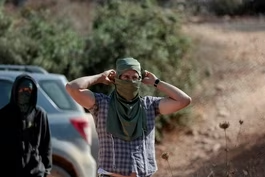
(SCREAMING) LEILA MOLANA-ALLEN: Masked gangs of settlers marauding through the streets armed with bats and Molotov cocktails, cars and homes smashed apart and set on fire, this is now the daily reality for Palestinians across the occupied West Bank.
As the violence spreads, no one is safe, a centuries-Old olive grove in ruins, flames licking at the stones of a fifth century church.
SULEIMAN KHOURIEH, Mayor of Taybeh, West Bank (through translator): They attacked us, moved their sheep into the churchyard, and they even tried to burn the church.
There's no difference between how the settlers treat Muslims or Christians.
LEILA MOLANA-ALLEN: Taybeh is one of the oldest continuously settled Christian communities in the world.
It appears in both the Old and New Testaments.
FATHER BASHAR FAWADLEH, Head of the Latin Parish, Taybeh: Everything began in this land.
LEILA MOLANA-ALLEN: Usually, at this time of year, the valley would be full of olive pickers.
Now locals are too afraid to venture onto their own land.
The trees are dying, their fruit rotting on the branch.
Across the valley, the hills are dominated by settlements.
Even as we stand here, we can see a car from a local settlement patrolling the groves.
Fleeing the relentless attacks, Christian residents have started to emigrate to the United States in droves.
The village has lost two dozen families already.
How is this for you personally, the responsibility?
FATHER BASHAR FAWADLEH: Huge and over my capacity.
But I have to be standing always and to raise my head up because I'm Palestinian, I'm Christian, I'm priest.
LEILA MOLANA-ALLEN: They have done what they can to replant the burned trees, but an olive tree takes nearly a decade to reach maturity.
The village's livelihoods are being destroyed.
Suleiman says, when the army does turn up, it's invariably to side with the settlers.
SULEIMAN KHOURIEH (through translator): The army and the settlers are one.
They both act the same way towards people, attacking them and kicking them out of their land.
LEILA MOLANA-ALLEN: As we're speaking, Suleiman gets a call.
There are settlers on his land.
He's too afraid to confront them.
Waiting on the road is Rabbi Arik Ascherman, one of a group of volunteers trying to pressure Israeli authorities to force settlers to abide by the law.
The settlers make their way into the valley, stopping next to the home of a Palestinian man and his child picking olives in their garden.
The makeshift fence they have erected won't do much to protect them.
He worries the international community, discussing a theoretical Palestinian state from afar, is ignoring the practical reality that, soon, Palestinians here will have little land left.
RABBI ARIK ASCHERMAN, Founder, Torah of Justice: The international community has like no backbone.
LEILA MOLANA-ALLEN: The army has told them to leave, and then they're paying their attention.
RABBI ARIK ASCHERMAN: For years and years and years, they have been acting with impunity, and certainly under this government.
Everything that they know says to them, we can do what we want and we're not going to pay any price for it.
There's going to be no consequences.
LEILA MOLANA-ALLEN: The settlers stay until sunset.
As is almost always the case, they're not threatened with arrest or physically forced to leave.
Israel's Prime Minister Benjamin Netanyahu has promised to curb the unprecedented wave of attacks.
BENJAMIN NETANYAHU, Israeli Prime Minister (through translator): We will act against this with all our might, because we are a state of law.
LEILA MOLANA-ALLEN: But critics say it's his own government that's created this atmosphere of impunity.
National Security Minister Itamar Ben-Gvir handed out weapons to settlers after the October 7 attacks.
Finance Minister Bezalel Smotrich has advocated destroying large Palestinian towns to isolate Palestinians.
And this government has sanctioned the building of dozens of new settlements, which are illegal under international law.
It's peak olive picking season in the West Bank, and Palestinian farmers are out harvesting their groves.
In Turmus Ayya, on the first day of the season, dozens of settlers armed with clubs, their faces hidden with black rags, descended on this grove; 53-year-old grandmother Afaf Abu Alia was chased and bludgeoned by a masked settler.
She was so badly beaten she suffered bleeding on the brain and had to be rushed to hospital.
The U.N.
says October was the most violent month on record since documentation of settler attacks began.
More than 260 attacks were recorded, an average of eight per day.
After international outrage, Israeli authorities say they have now arrested a man in connection with the attack.
But locals here say there's little chance he will face justice.
We found Afaf in hospital in Ramallah, where she told us about her traumatic assault.
AFAF ABU ALIA, Victim of Settler Attack (through translator): They beat me here on my shoulder, back and my arms.
They beat me over the head nearly 10 times, and then they beat the rest of my body.
It's really painful.
Now I can't go back to collect olives because of my brain injury.
LEILA MOLANA-ALLEN: But some victims never make it home.
In July, as 20-year-old Sayfollah Musallet attended his father's olives, a group of settlers armed with bats surrounded him.
His family heard he'd been taken to hospital.
What they found there was unimaginable.
REEM MUSALLET, Aunt of Sayfollah Musallet: Thinking that we're going to go see him, like he's hurt, he's injured.
But just seeing him there, it was really hard.
LEILA MOLANA-ALLEN: And what did they tell you at the hospital?
REEM MUSALLET: They told us he was beaten to death.
LEILA MOLANA-ALLEN: The family believes Sayfollah, nicknamed Sayf, might have been saved, but it took nearly three hours for a Palestinian ambulance to get permission to cross into the area to help him.
He bled to death alone.
REEM MUSALLET: He was like an older son to me.
He was very loving.
He was very loving.
He'd go into a room, he will -- always smiling, very full of life, very.
LEILA MOLANA-ALLEN: Sayf was an American citizen, a Florida native visiting family in the West Bank.
U.S.
Ambassador Mike Huckabee visited them after his killing, calling it a terrorist act and promising to take action.
They have heard nothing since.
REEM MUSALLET: He said we will get justice, Americans first.
But, until this day, nothing has changed.
LEILA MOLANA-ALLEN: Meanwhile, the violence shows no sign of stopping.
WOMAN: Are there are settlers on the way?
We need to be sure.
REEM MUSALLET: Like this morning, they were out here, they said.
WOMAN: Yes.
So you always kind of always have to be sure.
WOMAN: Every Friday, they cross from here.
REEM MUSALLET: They're like hunting for us.
They're just driving.
If they see any Palestinian person, that's it.
They're going to attack.
And we can't do anything about it.
LEILA MOLANA-ALLEN: Some are trying.
Jonathan Pollak is an Israeli activist who spent two decades working to protect Palestinian villages from settler and soldier violence.
He tried to stop the violence the day Sayf was killed and found himself the target.
JONATHAN POLLAK, Israeli Activist: I felt that we were at the edge of death when they attacked us.
There was nothing to stop them.
But at some point, Israeli soldiers came in and they literally peeled the settlers from on top of us.
Of course, they did nothing.
They arrested us.
LEILA MOLANA-ALLEN: He didn't know until his release from jail that the group, having assaulted him, then reached Sayf in his olive grove.
JONATHAN POLLAK: Racist lynch mob killed a Palestinian, beating him to death.
People like to say that it's complicated.
But, really, there's absolutely nothing complicated about a bunch of people going into other people's land, attacking them, killing them, imprisoning them, and stealing their land.
LEILA MOLANA-ALLEN: Sayf is just one of at least 21 Palestinians killed by settler violence since October 7, 2023.
The U.N.
reports more than 1,000 Palestinians have been injured in attacks this year, more than double the number injured last year, their homes burned, their fields and olive groves destroyed.
Seven settlers have been killed and 53 injured by Palestinians this year.
Yesh Din, an Israeli NGO working to protect the rights of Palestinians living under Israeli occupation, reports that, of 1,700 police investigations into Israeli violence against Palestinians in the West Bank in the past 20 years, 97 percent did not lead to a conviction.
Perpetrators of hundreds of other attacks this year remain at large.
And Jonathan says the impunity for Sayf's killing is the rule here, rather than the exception.
Last year, he watched another American, volunteer Aysenur Eygi, die next to him after she was shot by an Israeli soldier during a protest in the nearby village of Beita.
It was her first day in the West Bank.
The IDF said Aysenur was killed unintentionally during what it called a violent riot.
Jonathan and his fellow activists say the situation was calm.
JONATHAN POLLAK: You can see the soldiers up there by the black smoke.
They're pointing guns at us.
You don't know when they're going to pull the triggers.
LEILA MOLANA-ALLEN: Jonathan believes that, because the U.S.
supplies more than two-thirds of Israel's weapons, it is complicit in the death of its own citizen.
JONATHAN POLLAK: The bullet that killed Aysenur is an American bullet, and it is the bullet placed by the American government at the hands of Israel to suppress any Palestinian aspiration for liberation and self-determination.
And it is also used to send a message that it doesn't matter who you are.
If you stand with a Palestinian, your blood is cheap and there will be no accountability.
LEILA MOLANA-ALLEN: Reem says her family's experience has taught her that, even as Americans, they have no protection here, so Palestinians have little chance.
REEM MUSALLET: We lost Sayf.
We can't get him back, but we need justice.
Like every other place in the world, you commit a crime, you kill, you're behind bars.
Like, why is this the only country that they don't do that?
They -- they murder, next day they're out in the streets.
LEILA MOLANA-ALLEN: Reem now wakes each morning wondering when the next attack will come, whether her kids will return home safely from school.
All she can do is wait in fear.
For the "PBS News Hour," I'm Leila Molana-Allen in the occupied West Bank.
GEOFF BENNETT: In a statement to the "News Hour," the Israel Defense Forces said, for acts of violence directed at Palestinians or their property; "Soldiers are required to stop the violation and, if necessary, to delay or detain the suspects."
And on the settler killing of American Sayfollah Musallet in the West Bank, the State Department told the "News Hour": "Ambassador Huckabee has called for accountability for this murder and Embassy Jerusalem continues to closely follow this case."
Separately, a State Department spokesperson told us the killing by the IDF of Aysenur Eygi was a tragedy and we urge the government of Israel to complete a thorough and transparent investigation.
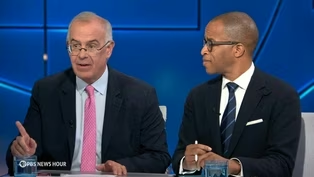
AMNA NAWAZ: President Trump had a series of seeming setbacks this week, raising some doubts about his grip on the GOP and his ability to govern in his second term.
For analysis, we turn now to Brooks and Capehart.
That is New York Times opinion columnist David Brooks and Jonathan Capehart of MS NOW.
Great to see you both.
JONATHAN CAPEHART: Hey, Amna.
AMNA NAWAZ: Let's talk about the latest AP poll that looks at the president's overall approval rating.
It's at 36 percent right now, which is a second-term low he's hit before, and it was lower at times in his first term, but the difference now is his approval on the economy specifically.
It's at 31 percent.
I want to put to you what Republican pollster Kristen Soltis Anderson wrote this week.
She said: "What's crucial to understand about Mr.
Trump's poor approval numbers is that unlike his last time in the White House, people now disapprove of him because of the economy, not in spite of it."
David, the president continues to insist affordability concerns are a Democratic hoax.
Why?
DAVID BROOKS: Well, if you look at the raw number, it's the same with Biden.
If you look at the raw numbers, he's got a bit of a case.
Median real wages after inflation are at their highest level in American history.
And then if you look about affordability, real wages are going up like this.
Food, clothing, all this stuff is not going up as fast as real wages.
The things that are going up really fast are health care and education.
So those things are going up really fast and housing in blue cities.
So there are some things that are really busting people's budgets.
So you got these overall numbers, which are OK.
But then when you ask people, consumer sentiment, the University of Michigan survey, it's in the cellar.
It's like an historic loss.
So people -- the economists can tell them they're doing OK.
But people say, no, I'm definitely not doing OK.
And in this case, the people know more than the economists.
AMNA NAWAZ: Jonathan, even Republicans I have talked to this week have said, he should not call it a hoax.
We have to meet people where their concerns are.
Is this sort of a gift to Democrats?
JONATHAN CAPEHART: Yes.
(LAUGHTER) JONATHAN CAPEHART: Yes.
Yes, it is.
I mean, at no point did President Biden say to the American people, it's a hoax what they're telling you, you're doing great.
He never said that.
What the president is doing is trying to convince people that what is happening to them in the supermarket, wherever they shop, that that's not happening, that they're not paying more for what they're buying for their family than they did a year ago, that they're not feeling the pain in the pocketbook.
And these poll numbers that are out today with the president's, you said the lowest approval rating on the economy, I always look not just at the overall approval rating, but what's his approval rating on any issue with Republicans.
And in the same poll, his approval rating has gone down nine points since March from 78 percent to 69 percent approval of his handling of the economy.
That's still very high, but it's a way -- it's a far comedown from where he's used to having support among Republicans, which is usually high 80s into the 90 percent.
AMNA NAWAZ: Look at his support among party lawmakers.
Let's take a closer look at Indiana this week and what we saw, because it was one of the most extraordinary examples so far of Republicans standing up to what Mr.
Trump has said he wants, state lawmakers they're voting against a redrawn congressional map that he wanted to see in place that could have given them extra seats or additional seats in next year's midterms.
David, are we seeing the limits of the president's power here?
DAVID BROOKS: I think a little.
I wouldn't overread that.
I mean, having a 36 percent approval is a lot different than having a 42.
It's much lower.
Politicians are going to get a little anxious.
But Indiana, A, it has a strong institutional Republican Party, where they believe in institutions.
B, it's got governors like Mike Pence and Mitch Daniels, former governors, who are not shy about rebutting the president.
So it's got a political culture that is likely going to want to stand up for the Constitution.
And that's what these lawmakers do.
It's incredibly heroic, what they did, and a lot of them did it.
And there was strength in numbers.
And if you read their quotes, it's all the institution.
This is not a constitutional thing we're doing here.
This is a betrayal of Constitution, a betrayal of voters.
It's a betrayal of democracy.
And they stood up and did the right thing.
And I think history will look very admiringly at them and very negatively about Donald Trump, Greg Abbott, the governor of Texas, and Gavin Newsom, the governor of California, all of whom betrayed the Constitution for the sake of partisanship.
AMNA NAWAZ: Do you think other Republican lawmakers in other states where there's a similar effort could follow Indiana's example or was Indiana unique?
DAVID BROOKS: I wouldn't recommend it in the South.
(LAUGHTER) DAVID BROOKS: Yes.
Well, as you begin to see 36 slip down approval -- slip down to 32, then you begin to see people wavering away.
AMNA NAWAZ: Jonathan, what do you make of that?
JONATHAN CAPEHART: I don't know about including Governor Newsom in the whole cavalcade of people defying the Constitution.
But the one other thing that I would add to this is, the bullying from the White House did not work.
There was a story today.
I cannot remember where I read it, but it quotes from people in the state legislature in Indiana who were saying that the threats that were coming from the White House, from officials just stiffened the spine of people.
Like, you don't talk to us that way.
You do not do this.
So, you can threaten us all you want.
And so the folks in Indiana, they're institutionalists, but they but they also have a moral core.
You're not going to talk to us like that.
And I hope other legislators around the country who are facing this pressure from the White House also resist.
AMNA NAWAZ: I want to take a step back and look at some of the bigger trends we saw this week, because there's the president's frustration over the Indiana map.
We saw a grand jury again refuse to indict Letitia James.
We know the Department of Justice is facing a deadline to release the Epstein files.
We're seeing bipartisan concern over the president's alleged drug boat strikes in the Caribbean.
So there's mounting frustration on a number of fronts.
At the same time, we're seeing a ramping up of the president's overtly racist rhetoric.
That affordability speech in Pennsylvania just devolved into an anti-immigrant, racist rant.
David, are those things related?
DAVID BROOKS: Unclear.
It could be just he's getting crankier and older.
He's not -- he's always talked about certain kind of countries when referring to certain developing world countries.
That was first term.
He's always used this kind of language.
Is he using it more nastily?
Yes.
Is it tied to his falling approvals?
I'm not sure.
I think there's been a shift in the mind-set of the administration compared to Trump one.
And we saw it not only in what he says in some random speech.
We saw it in the most important event of the week, which was the release of the national security strategy, where they talked about civilizational erasure.
This is taking some of that idea that we're -- we in the West have to fight off the hordes from the rest of the world.
That's not only in a speech.
That is the official foreign policy of the United States of America.
And so that culture war mind-set is now from maybe back of mind or medium of mind, now it's front of mind, both in random rhetoric, but also in policy.
JONATHAN CAPEHART: I don't think it's random rhetoric.
This is something that the president has done time and time again, when he was running for president the first time, when he became president, when he ran for president, especially the second time.
And now that he's president a second time, it is right there.
And when we have seen him go all in on racist rhetoric, it's when he's trying to scratch at that itch, that emotional, fearful itch to get people, I think, to get away from affordability and what's happening to them in their budgets and their pocketbooks, and get them to fearing and being afraid of their neighbors, being afraid of people around them as just a distraction.
And I think the more we talk about it, the more we shine light on it, the more we don't let him get away with saying what he said in Scranton.
I think the better it is for all of us.
It's not easy to hear the president of the United States say the things that he's been saying, not just in Scranton, but during this presidency.
We have to hold a mirror up to him just so that we are forced to contend with what he's saying.
AMNA NAWAZ: So let's look ahead for just a moment here briefly, because we saw in Congress this week a failure to be able to extend those enhanced ACA subsidies.
We know, fully expect tons of millions of Americans' premiums, health care premiums to go up.
David, it's one thing when beef prices go up, coffee prices go up.
When people can't afford their health care, what's coming down the pike here?
DAVID BROOKS: Yes, it's awful.
The health care costs bent after Obamacare, but now they're surging again.
And so I think we all probably know people, I certainly know people in my own life who are looking at catastrophic increases in their health care costs.
And I have to believe politics -- the government is going to act.
Maybe I'm an idiot.
It's likely.
But that they're going to do something in Congress, because the... AMNA NAWAZ: In the remaining days?
DAVID BROOKS: Well, I don't know.
The political costs to so many lives is so ruinous.
You would think they just give away some money to soften the blow.
JONATHAN CAPEHART: No, it's not going to happen.
And I say that because I'm looking at the calendar.
The House has four legislative days before they adjourn on December 18.
The Senate has five legislative days before they adjourn on December 19.
The subsidies end on December 31.
You know how many days it took to get the Affordable Care Act from introduction to passage?
Four hundred and twenty-seven days.
You cannot do this kind of policymaking in four or five legislative days.
You just can't.
AMNA NAWAZ: Jonathan Capehart, David Brooks, we appreciate your optimism and sense of hope always.
But we appreciate it.
DAVID BROOKS: It's always ridiculous, isn't it?
AMNA NAWAZ: But we appreciate you both being here every week.
Great to see you.
JONATHAN CAPEHART: Thanks, Amna.
DAVID BROOKS: Thank you.
AMNA NAWAZ: And be sure to watch "Washington Week With The Atlantic" tonight right here on PBS.
Yours truly will be among the panelists joining moderator Jeffrey Goldberg for analysis of President Trump's pressure campaign to end the war in Ukraine.
GEOFF BENNETT: And on the next "PBS News Weekend," a husband-and-wife team discuss their 40 years of capturing dazzling wildlife photography in Africa.
That's Saturday on "PBS News Weekend."
And that's the "News Hour" for tonight and this week.
I'm Geoff Bennett.
AMNA NAWAZ: And I'm Amna Nawaz.
On behalf of the entire "News Hour" team, thank you for joining us and have a great weekend.
Brooks and Capehart on Trump's recent series of setbacks
Video has Closed Captions
Clip: 12/12/2025 | 10m 5s | Brooks and Capehart on Trump's recent series of setbacks (10m 5s)
Israeli settler attacks halt Palestinian olive harvest
Video has Closed Captions
Clip: 12/12/2025 | 11m 21s | Israeli settlers attack Palestinians with impunity, halting West Bank olive harvest (11m 21s)

News Wrap: Preservationists sue Trump over ballroom
Video has Closed Captions
Clip: 12/12/2025 | 6m 3s | News Wrap: Preservationists sue Trump over his White House ballroom renovation (6m 3s)
Nobel Peace laureate's harrowing escape from Venezuela
Video has Closed Captions
Clip: 12/12/2025 | 5m 2s | Venezuelan opposition leader makes harrowing journey to receive Nobel Peace Prize (5m 2s)
Trump's executive order limits state regulations of AI
Video has Closed Captions
Clip: 12/12/2025 | 7m 39s | Trump’s executive order limits state regulations of artificial intelligence (7m 39s)
What we know about the Epstein photos released by Democrats
Video has Closed Captions
Clip: 12/12/2025 | 4m 22s | What we know about the Epstein photos released by Democrats (4m 22s)
Why an Indiana Republican defied Trump's redistricting push
Video has Closed Captions
Clip: 12/12/2025 | 7m 25s | Indiana Republican explains why he defied Trump and rejected congressional redistricting (7m 25s)
Providing Support for PBS.org
Learn Moreabout PBS online sponsorship
- News and Public Affairs

FRONTLINE is investigative journalism that questions, explains and changes our world.

- News and Public Affairs

Amanpour and Company features conversations with leaders and decision makers.










Support for PBS provided by:
Major corporate funding for the PBS News Hour is provided by BDO, BNSF, Consumer Cellular, American Cruise Lines, and Raymond James. Funding for the PBS NewsHour Weekend is provided by...