But Why – A show for curious kids
Why do we need the sky?
5/8/2026 | 2m 22sVideo has Closed Captions
Why do we need the sky? Asks Mary from New York.
The sky is one of the most important aspects of life on Earth. It contains a number of different layers, each responsible for its' own safety measure to keep living here a little more possible. Let's learn what each layer does in this episode of But Why Bites!
Problems playing video? | Closed Captioning Feedback
Problems playing video? | Closed Captioning Feedback
But Why – A show for curious kids is a local public television program presented by Vermont Public
But Why – A show for curious kids
Why do we need the sky?
5/8/2026 | 2m 22sVideo has Closed Captions
The sky is one of the most important aspects of life on Earth. It contains a number of different layers, each responsible for its' own safety measure to keep living here a little more possible. Let's learn what each layer does in this episode of But Why Bites!
Problems playing video? | Closed Captioning Feedback
Where to Watch But Why – A show for curious kids
But Why – A show for curious kids is available to stream on pbs.org and the PBS app.
Providing Support for PBS.org
Learn Moreabout PBS online sponsorshipMore from This Collection
Fun facts about the Earth and beyond!
Are there other dwarf planets like Pluto?
Video has Closed Captions
Are there other dwarf planets like Pluto? Asks Isaac from Iowa. (1m 53s)

What are the dog days of summer?
Video has Closed Captions
What are the dog days of summer? Probably not what you think. Woof! (2m 25s)

Video has Closed Captions
How do you sink in quicksand? Asks Jack from Texas. (2m 10s)
Are there really no trees in Iceland?
Video has Closed Captions
A gorgeous country full of majestic and sweeping beauty, but it feels like there are no trees! (1m 16s)

Why do waterfalls not run out of water?
Video has Closed Captions
Why do waterfalls not run out of water? Asks Connor from New Zealand. (1m 57s)
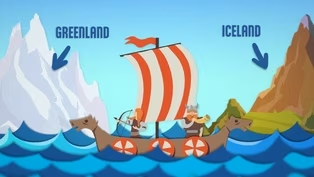
Why is Iceland green and Greenland icy?
Video has Closed Captions
Why is Iceland green and Greenland icy? Asks a number of viewers. (2m 39s)
Video has Closed Captions
How are glaciers formed? Asks Eena from British Columbia. (2m 29s)
Are there animals or plants that can live forever?
Video has Closed Captions
Are there animals or plants that can live forever? Asks Eleanor from New York. (2m 25s)
Why does Iceland have so many volcanoes?
Video has Closed Captions
Why does Iceland have so many volcanoes? (1m 46s)
Providing Support for PBS.org
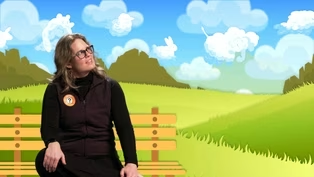
Learn Moreabout PBS online sponsorshipSometimes the sky can seem a little two dimensional, but there's a lot more going on up there than you think.
And our sky might just be the reason for life on Earth.
Why do we need the sky?
Our big, beautiful blue sky is actually composed of five distinct layers that make up our atmosphere.
Those layers are filled with different combinations of elements like oxygen, nitrogen, carbon dioxide, and lots more.
It's like a layer cake that keeps air in our lungs and protects us from being blasted by the sun's harmful radiation.
The layer we call home is called the troposphere.
It's where we breathe, where storms build and dissolve, and where nearly all the clouds form.
It's the smallest part of the atmosphere, but also the most dense, thanks to the weight of the layers above it.
Climb about four miles up and the stratosphere begins.
This region is home to the ozone layer, a concentration of gas responsible for absorbing the sun's harmful ultraviolet radiation before it gets to us.
Even higher is the mesosphere, starting about 31 miles above Earth.
Too thin to do much, but just thick enough to matter.
When meteors come down from space it's the mesosphere that catches them and slows their entry, turning them into shooting stars we can see from the ground.
Once we get to the next layer, the thermosphere, things start getting weird.
53 miles up, the thermosphere is the first layer that catches high energy radiation from the sun.
Because of this, it has a much wider temperature swing than other layers, from as low as -184°F, all the way up to 3600 degrees at the top.
The last layer before we get to space is the exosphere, 375 miles up from the surface of the Earth.
This is where satellites can safely orbit and where atoms and molecules escape into space.
That's a lot to take in.
So let's think about it this way.
It may look like a big expanse of nothingness up above us, but our sky is doing a lot of work for us behind the scenes.
To make sure you never miss But Why, like this video and subscribe to our channel and find out more at butwhykids.org.
 New Episode
- Science and Nature

Explore scientific discoveries on television's most acclaimed science documentary series.


 New Episode
 New Episode







Support for PBS provided by:
But Why – A show for curious kids is a local public television program presented by Vermont Public