
E7 | BBQ Smoker; Picking Out a Tree | Ask This Old House
Season 25 Episode 7 | 23m 42sVideo has Closed Captions
Mauro restores a rusty BBQ smoker; Jenn shows how to pick out and plant a tree.
Mauro Henrique heads to Kansas City to restore a rusty BBQ smoker with high-heat paint. Then Kevin O'Connor, Jenn Nawada, and Lee Gilliam look back at some favorite tree moments from the last 25 years. After, Jenn teaches a homeowner how to pick out a tree from a nursery and plant it.
Problems playing video? | Closed Captioning Feedback
Problems playing video? | Closed Captioning Feedback
Funding for Ask This Old House is provided by The Home Depot and Renewal By Andersen.
Support provided by:


E7 | BBQ Smoker; Picking Out a Tree | Ask This Old House
Season 25 Episode 7 | 23m 42sVideo has Closed Captions
Mauro Henrique heads to Kansas City to restore a rusty BBQ smoker with high-heat paint. Then Kevin O'Connor, Jenn Nawada, and Lee Gilliam look back at some favorite tree moments from the last 25 years. After, Jenn teaches a homeowner how to pick out a tree from a nursery and plant it.
Problems playing video? | Closed Captioning Feedback
Where to Watch Ask This Old House
Ask This Old House is available to stream on pbs.org and the PBS app.
Keep Exploring


This Old House Insider Newsletter
Get This Old House exclusive stories, tips, and behind-the-scenes information delivered right to your inbox every month.Providing Support for PBS.org
Learn Moreabout PBS online sponsorshipKevin: Our experts travel across the country to answer questions about your house.
Today, Mauro heads to Kansas City to lend a hand to a homeowner whose barbecue smoker is in need of a little TLC.
Mauro: Once you start here, you're gonna go all the way to the end.
Kevin: Then Jenn takes a field trip to a local nursery to help a homeowner select the right tree for her front yard.
Jenn: So, we have your beautiful Japanese snowbell, which I do think is going to work perfectly here.
Tara: I love it!
♪ Kevin: All that's coming up next on "Ask This Old House."
♪ ♪ Mauro: Today we're in Kansas City, one of the barbecue capital of the world.
With over 100 joints across the city, this isn't just food.
It's tradition.
The culture extends beyond the iconic restaurants to national competition.
Today I'm meeting one of those competitors whose prized smoker needs a little TLC.
Mike: Hello, Mauro.
Mauro: Hey, Mike.
Mike: How you doing?
Nice to meet you.
Mauro: Nice to meet you, Brendan, nice to meet you.
You guys wrote me about a smoker grill.
Mike: Yes.
Mauro: Alright.
Talk to me a little bit about it.
Mike: We got it about a year ago and it's starting to rust out.
And we were just looking for ways to kind of clean it up, keep it lasting so that we can use it over and over.
It's a great smoker, and we'd kind of like to keep it going that way.
Mauro: Alright.
Cool.
Let's bring this outside so we can take a closer look.
Mike: Okay.
So here we go.
Mauro: Oh.
Look at this.
This is nice.
How old is this, Mike?
Mike: It's about 20 or 30 years old.
I've had it for about a year or so now.
Mauro: Alright.
Cool.
Well, I can see that it has some rust, some a little grease here and there.
First thing before we do any prep work, I like to put a tent here.
We work under the shade.
Mike: Okay.
Mauro: Alright?
Mike: I like shade.
Mauro: Sounds good.
And who is that?
Mike: This is our dog, Stormy.
She likes to kind of interrupt things as we go.
Mauro: She's gonna help us?
Mauro: I think so.
Mauro: The extra help is always good.
♪ Okay, guys.
Tent is up.
But, Brendon, talk to me about this grill.
It looks like you guys use it a lot.
Brendan: That's a question for him.
I have no clue how this thing works.
Mauro: Mike?
Brendan: So we've had it about a year now, and we've used it in some competitions.
Mauro: Okay.
Mike: Um, you know, various places around the state, and it's worked well for us.
It's an offset smoker controlled with the dampers on the front.
And then our vent stack here at the top.
Um, as we put the coals in it, the firebox here.
Control the airflow through here... Mauro: Alright.
Mike: ...into the coals to get the fire going.
And then as it comes up through the cook chamber, the baffle that we have here will help control that.
So all our meats sit in here.
Water pans underneath.
Mauro: Perfect.
Mike: It has worked well for us.
Mauro: And you got some rust going around.
Mike: Yeah.
Just kind of wondering how that happens.
Mauro: Well, a couple of reasons for that.
If it stays out in the weather, you're gonna see something like this.
Or it's 'cause oxidation.
It's moisture and oxygen.
That can also cause some of this rust going around.
And also when you to scrape it off ,to remove some debris in there.
it goes down to the metal, and it's starting to rust like this.
Let's close this up.
We'll come back.
And we'll start working on it.
Mike: Alrighty.
Mauro: Well, guys, ready to go?
We'll get the tarp down to protect the floors.
We've got the tent because, you see, it's raining right now.
I know we're not doing this inside of the grill.
So what are your plans for that?
Mike: So what happens here is all the grease and the smoke that builds up kind of forms that layer of creosote.
I'll come in at the end of the year, scrape all that out, clean it up.
So that will not be needed to be done today.
Mauro: Perfect.
I found some cardboard boxes in your garage.
I cut out, and I protect this area here.
Hope you don't mind.
Mike: No, it's perfectly fine.
Mauro: Alright.
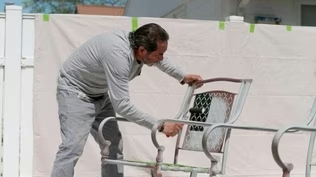
First, what I'm gonna do... I'm gonna use my wire brush.
The wire brush, we're gonna get this area here, which is very hard to reach.
At the edges like this.
You put at a little angle, and you press it down.
That works really well.
And then, for the flat surface, you're gonna have my first tool when I start to paint.
Five-in-one.
See this bevel here?
It works as a scraper.
You can go just like that.
And you can remove a lot of debris from the surface.
And let's go to work.
♪ Brendan: How deep should we go with this?
Like, scrape with it?
Mauro: You don't have to go too deep.
♪ ♪ ♪ Alright, guys.
Ready to go for the next step?
Sanding.
Mike: What grit are we using?
Mauro: We're using 220.
Mike: Okay.
Mauro: Because we just want to smooth the surface out a little bit.
Mike: Could I use an orbital sander?
Mauro: You could.
By hand, you get a better result when you get closer to the edge.
♪ Alright, guys.
Time to wash it off.
And make sure that we get all the grease off of this barbecue.
Alright?
So the paint will stick.
Let's do another round with just clean water and make sure we get all the soap off.
♪ When you paint your grill, it's important to use a high-heat paint.
Mike: Yeah, a couple years ago, I tried to repaint one, an older one, that the paint just started flaking off after two or three cooks.
Mauro: Okay.
Here we have 600 degrees.
This one is 1,200 degrees.
And this one is 2,000 degrees.
When you paint the grill, the higher you go, the more protection you get for your grill.
Mike: Well, that's good because on that firebox, it could get up to 1,000 degrees, which could be pretty hot.
Mauro: Okay.
This one is 1,200.
It's too close.
And this one is 2,000.
Let's get the 2,000 on it.
Mike: Alrighty.
Mauro: Okay.
Let me show you guys how to do the first pass.
Brendan: How close are you supposed to spray this?
Mauro: Um, usually you go from 5 to 6 inches off the surface, and then you're gonna press this-- full press.
And you go do your first pass, and you come back.
You're gonna overlap each pass by 50%, okay?
Mike: Is there a special thing we have to do to prevent drips?
Mauro: Yeah.
Don't stop and go.
Mike: Okay.
Mauro: Once you start here, you're gonna go all the way to the end.
One pass and come back.
If you stop, then you're going to create some drip.
Alright, guys.
Take a look at this.
First coat.
What do you guys think?
I think it looks awesome.
Mike: I think it looks really good.
About how long do we need to wait for it to dry?
Mauro: Uh, we're gonna let it sit for about an hour, hour and a half.
Then we'll come back and we put the second and final coat on.
Mike: Okay.
Mauro: Alright?
Mike: Alright.
Mauro: Good.
Alright, guys.
It has been about an hour.
It's time to put the second and final coat.
Mike: Okay.
♪ ♪ ♪ ♪ ♪ Mauro: Hey, guys.
Mike: Mauro, we can't thank you enough.
It looks great.
I'm sure it'll be lasting for quite a while now.
But we couldn't let you leave without some KC barbecue.
Mauro: Oh, is that for me?!
Mike: That is for you.
Mauro: Oh, that looks delicious.
Look at this.
One question.
Mike: Yes, sir.
Mauro: Can I have it to go?
Mike: You sure can.
Mauro: Alright.
Enjoy your grill, guys.
Mike: Thank you very much.
♪ Kevin: When you think of "Ask This Old House," you may think of all the house calls that we do inside people's homes.
But we love the outdoors just as much, especially the trees.
Roger: This is an Aristocrat pear.
Jenn: Over here is a threadleaf Japanese maple.
Lee: I have three arborvitaes.
Roger: A kousa dogwood with that beautiful white flower in June.
Jenn: This is a ginkgo tree.
It's a dwarf ginkgo.
Man: Great spot.
Yeah, I love it.
Roger: You weren't kidding when you said you had a lot of different species of bonsai.
Look at this place!
Man: It's beautiful.
There's a lot to look at.
Roger: Well, this tree looks great.
Jenn: Beautiful.
Kevin: Ah.
Something about a tree, right?
Jenn: I know.
Kevin: Just so substantial.
We get so many questions about them.
People want us to plant them.
You guys are doing it all.
I mean, what is it about a tree that just makes it so unique in the landscape?
Jenn: I mean, it sets the space, right, from a design perspective.
It can give you shade.
It can give you privacy.
Lee: Conversation piece.
Obviously.
You know, that tree looks beautiful in the corner or in the walkway, down the walkway, things like that.
Jenn: Or anticipating when it's going to bloom in the spring.
You go through this long, hard winter, and then pops.
A Cherry Blossom festival.
I mean, I am blown away.
Man: Over 3,000 trees were sent as a gift to the United States from Japan and planted all over D.C.
Roger: So what do you think?
Man: It's gorgeous.
Roger: So you need to understand how tall a tree gets when it's mature, how wide it gets, and how much sun it needs.
Now we got 9,000 pounds of root ball.
1,000 pounds for the tree.
That's five tons of material in this tree spade.
Nice and easy.
Now, if you look right here, you'll see there's a root right there that runs right up against the trunk of the tree, and that will actually grow around there and girdle that tree, so we have to get that out of there.
So we're just gonna cut it out.
Kevin: Questions that you get when they're picking them or how to treat them?
Like, what comes up all of the time?
Lee: Real simple.
It's like... what color is it going to be and how big it's going to be.
And then I have to follow it up with, "What color would you like?"
"We can't plant it too close to the house."
"We got to watch out for power lines."
Things like that.
Jenn: Yeah, you really want to, like, check out the location, the space, anticipate, know the height, the spread.
Look at your zone, the hardiness zone, when it's going to thrive, if it's going to take a drought or a hard winter.
Because it's going to be there forever.
And like you said, off the house is a big one because people make the mistake planting it too close.
You know, if a fire were to ever happen.
Or it could also invite animals and stuff to your house.
So planning for the future.
Sometimes people don't want to wait because it seems so tiny at first.
But if you have that vision to do -- you know, look into the future, it's the best.
Kevin: It's not the kind of thing you want to get wrong.
Jenn: Right.
Kevin: Misplace a hosta?
Eh!
Jenn: Right.
Kevin: Pick the wrong tree?
Put it in the wrong place?
Lee: You're in trouble.
Yeah.
What I noticed: fabric paper.
Fabric paper is a no-no.
Does not allow the tree to get water.
Roger: Well, crabapples are vigorous growers, and they do need pruning, and that's what this one needs to help it out.
Nice and easy.
Alright.
Kevin: Maybe it's putting you on the spot.
Maybe it's like choosing your favorite kid.
But do you have a favorite tree?
Lee: I like Japanese maple.
Jenn: Okay.
Lee: It has movement through the tree.
It has the color.
Once those leaves pop out, you have that maroon color, or the green ones.
When they lose all their leaves, you have that movement in it.
It's like a diamond.
It's a diamond of the yard, I call it.
Jenn: Aww.
Stop!
Lee: I don't want to start crying, but, yeah.
Kevin: Come on.
Jenn: What about you?
Kevin: The cercis canadensis.
The redbud tree.
Jenn: Look at you with the Latin.
Kevin: Yeah, it's just because we named the dog after it.
Woman: Cercis.
Come on.
Come on.
Kevin: It's my wife's favorite tree.
So her favorite became my favorite, but I also-- If I could pick two.
The European beach.
Like, that copper color with those long, sloping arms.
Jenn: Pendulous.
Kevin: Oh.
Pbht.
Wow.
Well!
Wow.
I thought cercis canadensis was good enough.
Pendulous.
What's yours, Pendula?
Jenn: [ Laughs ] Well, it's so hard for me because I love different trees in different applications.
I love the dogwoods that bloom in the beginning of the season, the cornus florida.
There's a bloom for every time.
I like picking trees for foliage.
Like the parrotia tree, the one we planted for Roger.
That one was spectacular.
I love that tree.
It's an ironwood.
I love evergreens.
It just depends-- For me, it depends on where they are and... Kevin: How many trees do you think Roger Cook planted over the course of his career?
I mean, thousands, right?
Jenn: Hundreds of thousands.
Guaranteed.
Right?
Kevin: Unbelievable.
And to your point, that last tree that we saw was the one we planted in his memory.
Jenn: The Persian ironwood.
Kevin: And it still looks good, right?
Jenn: It's thriving.
It's living on.
Kevin: Well, go plant a tree.
Lee: I think I will.
♪ Jenn: You must be Tara.
Tara: I am.
Jenn.
Nice to meet you.
Jenn: Nice to meet you.
So you wrote me in about a tree?
Tara: I did write about the tree.
This tree right over here.
Jenn: Okay.
Tara: Unfortunately, it died during a drought a few years ago, and we had someone come take it down, thinking we would be able to get a new one rather quickly, and that didn't really happen.
So, what I didn't realize when I had them take it down was that we were going to lose all the privacy in our sitting room.
Jenn: Yeah, you're pretty exposed, right?
Open to the street.
Tara: Yeah.
Jenn: You want to think about a few things when you're looking for a tree.
Tara: Okay.
Jenn: First of all, accessibility.
Like, how's the tree going to get here?
Sometimes it's out back, and you have to go through a fence.
But I think we have a clear shot right here from the street.
So that's a bonus.
Tara: Awesome.
Jenn: I see that the old stump is off center from the bay window.
And what I'd like to do is remove that stump.
And then when you do the new tree, let's go right off the middle line of the bay windows.
Tara: Awesome.
Yeah.
I love that.
That's a great idea.
Jenn: And then maybe pull it out a little bit.
So, one, accessibility.
Two, look at your surroundings.
Like, what's going to complement other plants.
Tara: The other landscaping.
Yeah.
Jenn: Mm-hmm.
But also things like overhead wires.
See those that are going to the pole in the street?
Next, you want something that's evergreen or deciduous, which means the leaves fall down.
That's flowering.
Tara: I want flowering.
Jenn: You want flowering.
Tara: Want lots of flowering.
Jenn: Great.
So that narrows it down, too.
You want to also think of understory tree.
So understory would be about 15 to 20 feet.
Tara: Okay.
Jenn: You don't want anything like a sugar maple or oak or a Norway spruce.
Like, it'll just dominate the area.
Tara: We don't want that.
Jenn: Yeah.
So something flowering, understory, and that's going to fill in the space.
Tara: Yep.
Jenn: But instead of trying to think exactly what to do, let's just go to the nursery.
Tara: Let's just head there.
Let's just do it.
Jenn: Yeah.
I think once you see it, we'll know it.
Tara: I'm a very visual person, so let's do that.
Jenn: Alright.
Cool.
Tara: Yeah.
Awesome.
♪ Jenn: Alright.
This is the area that has all the understory trees.
Tara: Okay.
Jenn: And I think any of these would work well in your yard.
But, Andrew, I'll let you take it.
Andrew: Yeah.
You got a lot of options here we'll look at.
I got some cherries, some snowbells.
But I think first we should look at some dogwoods.
Tara: Okay.
Andrew: Here you got a kousa dogwood.
I'd pick a kousa, Korean dogwood, for that spot because they'll stay a little smaller.
Tara: Okay.
Andrew: This time of year, the kousas get really quite big, beautiful flowers.
Um, they'll get-- There's only a few on them now, but as the tree matures, you'll get much more of them.
Really be covered in them.
Jenn: They're also called the Father's Day tree because they bloom around Father's Day usually every year.
Tara: Okay.
Yeah.
Jenn: So when we're looking at all these trees, look at the branching structure, as well.
Tara: Okay.
So I want something dense, right?
Because the way I want it to give us some privacy in the big window.
Um, maybe a little more denser than this, but I still like-- I like this tree.
I like the flowers and everything.
Jenn: Okay.
Tara: It's a contender.
Jenn: Alright.
Andrew: Awesome.
We can find something denser for you.
Tara: Alright.
Jenn: Yeah.
Andrew: So here.
This is the first cherry tree we'll look at.
It's an Okame cherry.
My favorite kind.
It's one of the ones you see down at Washington, D.C.
You can see the pink flowers right there.
Very early spring.
Tara: Okay.
Andrew: Early April.
Jenn: Everything lights up.
Andrew: That's about the actual size.
So they're quite small.
Um, but there will be thousands of them on the tree.
Jenn: Like, blanketed across.
Yeah.
Tara: Oh, that's beautiful.
Andrew: Yeah.
Tara: So will this come out a little bit more?
Andrew: Yeah.
It'll be-- It'll be taller than it'll be wide.
But, yeah, it'll get 10, 12 feet wide eventually.
Tara: Okay.
Okay.
Jenn: That'll be nice and dense.
But it's a spectacular bloom.
You cannot go wrong with it.
Tara: Oh.
Okay.
Jenn: But there are some other contenders that we could check out, as well.
Andrew: This way.
Tara: Great.
Jenn: After you.
Tara: Mm-hmm.
Andrew: Right over here, we have a Kwanzan cherry.
Another type of pink cherry.
Uh, flowers a bit later.
You get these beautiful, big, pink double flowers on it.
Tara: Okay.
It's beautiful.
But I think I'm looking for something a little bit broader.
Andrew: Awesome.
Tara: Okay.
Andrew: Yeah.
Right this way.
Tara: Great.
Andrew: This here is a Japanese snowbell.
Also called styrax.
What do you think of this one?
Tara: I really like it.
I like the shape.
Jenn: Yeah, the styrax japonica.
Japanese snowbell.
So these flowers, they just opened up.
But before they open, they hang like little bells.
So it's absolutely gorgeous.
And the structure.
I really like how it's tight.
It stays together.
Then it's going to grow out.
So I think it's going to give you great coverage for that bay-window area.
Tara: Yeah.
Jenn: Look how much more tight the branching structure is.
And then it gets all tangled up when they're in the nursery, so sometimes after you plant it, you kind of untangle the branches so it sends it out in the direction that it should grow in because you don't want cross branches.
So that's something to do a little bit later on.
Tara: Okay.
I love it.
I think it's going to look really great in the space on the lawn and the covering that I need for the-- um, for the front.
So I'm ready to-- I'm ready to take the old girl home.
Jenn: Alright.
Andrew: We have a winner?
Tara: We have a winner-winner.
Andrew: Great.
I'll get it all wrapped up for you and ready to have it delivered to your home.
Tara: Thank you.
Jenn: Thanks, Andrew.
Tara: Appreciate it.
Thank you.
Andrew: Sounds good.
Thanks to you guys.
♪ Jenn: So we have your beautiful Japanese snowbell, which I do think is going to work perfectly here.
Picking out location.
Tara: Yeah.
Jenn: I'd like to move a couple feet back from that existing stump and then center it right here off the bay window.
Tara: Yep.
Jenn: Does that feel about right?
Tara: That does, because that'll give me the privacy that I want.
Jenn: Okay, so before that, I'd like to get that stump out of here.
I've got a guy.
I'd like to get rid of all the roots and everything just so the new tree has space to grow.
Oh, yeah.
Beautiful.
And that's it!
Since he's here, I'd like to have him dig the hole, as well.
Alright, so what we want to do is measure the depth of the root ball with the depth of the hole.
You want to make sure that once you roll it in, it's at the proper height.
So I'm going to take the end of my shovel, using this as a measuring line for the level surface.
Use my finger right here to measure the approximate height.
And I'm going to take it down here.
And I think that looks pretty good.
So what we're going to do is tip the tree that way and slowly spin it so it drops into the hole.
Tara: Okay.
Yep.
Jenn: Okay?
So get the bottom of the root ball.
Okay.
And then I'm going to pivot it this way.
Tara: Yep.
Jenn: And then go slow.
Okay.
That's good.
Tara: Yep.
Jenn: I'm going to hold it in place.
And then you look if it's in the center.
Tara: Yep.
Beautiful.
Yep.
Centered.
Looks good.
Jenn: So the next steps are we're gonna take off this webbing.
Tara: Yep.
Jenn: I've got my friend Tommy.
He's going to bring the wire cutters.
Right.
We're going to cut off the basket.
The wire basket.
And then we're gonna peel the burlap off.
Tara: Okay.
Jenn: Then we're going to scrape back and see where the root flare is.
The root flare is the bottom of where the trunk meets the top of the root ball.
Tara: Okay.
Jenn: That doesn't want to be buried.
And then same goes for mulch, right?
Avoid mulch volcanoes when you go to mulch it.
You don't want to go back up.
You see that everywhere.
Tara: Okay.
Jenn: And it's detrimental to the tree.
Tara: Awesome.
Tom K.: I think we're ready to backfill.
Jenn: Great.
Tara: Let's do it.
Jenn: So what I'm gonna do is put some starter fertilizer... Tara: Okay.
Jenn: ...around the tree.
And then I want you to fill it with water.
Tara: Okay.
Jenn: And we'll let it soak in before we apply the rest of the backfill.
Tara: Okay.
Yeah.
That's great.
Jenn: And then maybe come back this way and hit the other side.
Nice.
Last couple steps.
We're going to put mulch around the tree.
Tara: Yep.
Jenn: And then we're going to take the wrap off the trunk.
Tara: [ Gasps ] Oh, goodness!
Jenn: That's pretty beautiful, right?
Tara: It's pretty beautiful.
Yeah.
Jenn: So, see how it was wrapped... and then where we said our root flare was?
Tara: Yes.
Jenn: All the way down here.
A lot of people-- You'll see in supermarkets or places or people's yards.
They do this mulch volcano around the tree.
Tara: No-no.
Jenn: No good.
So what we're going to do... You want to keep it flat.
We call it a tree saucer.
Tara: Alrighty.
Kevin: And so when we water, it helps keep the water in, not just sheet and run off.
Tara: Okay.
Jenn: So what you want to do is let it go until you see it start to puddle up.
Tara: Okay.
Jenn: And let the water soak back down.
Tara: Yep.
Jenn: And then do it a couple times like that.
Alright.
So what do you think of the final placement?
Tara: I love it.
I love that it's centered.
It's in the middle.
And it gives me the privacy that I need.
Tara: And from the street side, I mean, you walk by, and one tree is so impactful.
So I'm so happy for you.
A couple things for homework.
Go around the tree.
Remember what we talked about earlier.
All the cross branches?
You know, loosen everything up.
Make sure everything's pointing out in the right direction.
Uh, twice a day, water.
Tara: Absolutely.
Jenn: Fill it.
Let it soak in.
And then we put some grass seed down to cover this up, so hit that with some water, as well.
Tara: Absolutely.
This was great.
Thanks so much.
Jenn: Yeah.
Nice to meet you.
Tara: Nice to meet you.
Jenn: Alright.
Good luck!
Tara: Okay!
♪ Kevin: Next time on "Ask This Old House"... it's the holiday season at the barn.
First, Tommy invites a homeowner who he helped in Chicago to share a special toy she's made using the tools Tommy set up for her over a decade ago.
Tom: I absolutely love it.
Kevin: And...do you wish there was an easier way to fill your pots for all the holiday gatherings?
Richard helps a homeowner install a pot filler at their stove.
All that on "Ask This Old House."












Support for PBS provided by:
Funding for Ask This Old House is provided by The Home Depot and Renewal By Andersen.